The Order of St Arnulf
Anulus redit The ring returns
The Order of St Arnulf is a society of the descendants of Charlemagne and their friends. Its patron is St Arnulf of Metz, the saint the Carolingians venerated and held to be their forefather. It keeps his memory, records proved lines of descent from Charlemagne, promotes the study of genealogy and heraldry, and meets each year on his feast, 18 July.
Memory
We honour the seventh-century bishop and statesman whom the Carolingians venerated and held to be their forefather.
Proof
We record descents from Charlemagne that are supported by evidence at every generation.
Study
We promote the study and practice of genealogy and heraldry.
Fellowship
We bring Charlemagne’s descendants and their friends together, at table on the feast day and through the year.
A letter from the High Steward
Welcome.
St Arnulf died about the year 640. The Carolingians venerated him and held him to be their forefather, and the descendants of Charlemagne now living are very many. Most of them do not know it, and few of those who do can show how.
The Order is being formed for those who can show how, and for the friends who have helped them do so. It charges no subscription and gives no titles. It asks that a claimed descent be proved, and it offers in return the company of others who care about genealogy and heraldry, and a dinner each year on the saint’s feast.
We meet for the first time on 18 July 2027. If you would like to be among the founding members, we would be glad to hear from you.
Aynsley Damery
High Steward
St Arnulf
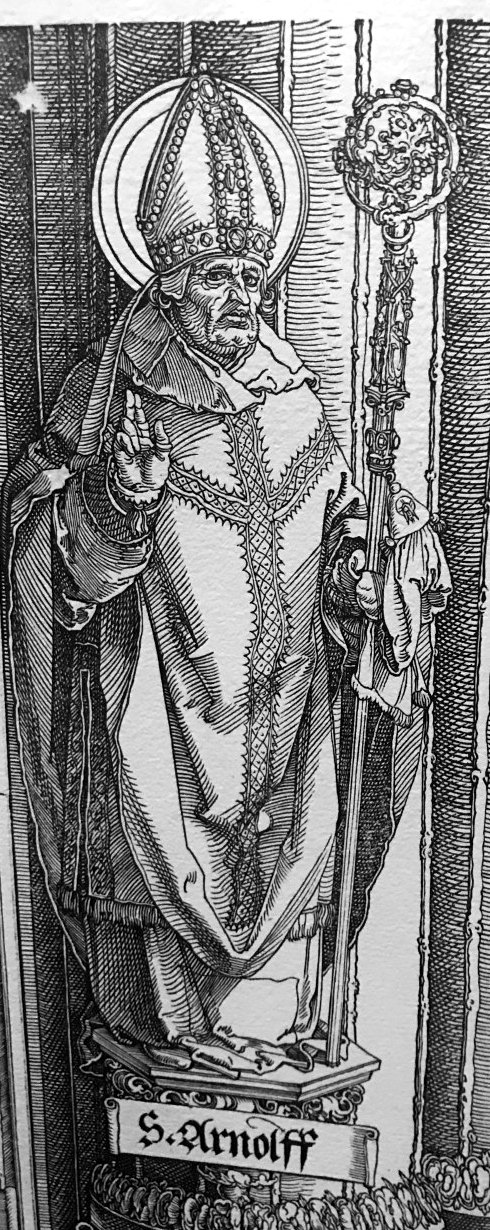
Arnulf was born about 582 into a noble Frankish family and rose in the service of the kings of Austrasia, the eastern Frankish kingdom. In 613 he and Pepin of Landen were among the leaders who brought Austrasia under King Chlothar II. Soon afterwards he was made Bishop of Metz, and for some years he was a chief adviser to the young King Dagobert.
He had married before he became a bishop. Paul the Deacon, who wrote a history of the bishops of Metz about 784 and says he had his account of Arnulf from Charlemagne himself, records that Arnulf had two sons, Ansegisel and Chlodulf. Ansegisel married Begga, the daughter of Pepin of Landen. Their son was Pepin of Herstal, his son was Charles Martel, his son was Pepin the Short, and his son was Charlemagne.
The descent from Arnulf was the Carolingians’ own tradition. In 875 Louis the German named him as an ancestor in a charter that survives in the original. From Ansegisel to Charlemagne the line is not in dispute. The link between Arnulf and Ansegisel is first stated by Paul, 140 years after Arnulf’s death, and historians describe it as generally accepted but not strictly proved. The Order therefore takes Arnulf as its patron and reckons membership from Charlemagne.
Late in the 620s Arnulf gave up his see and withdrew to the Vosges, near Remiremont, where he died about 640. His body was brought back to Metz and buried in the church that later bore his name.
The ring
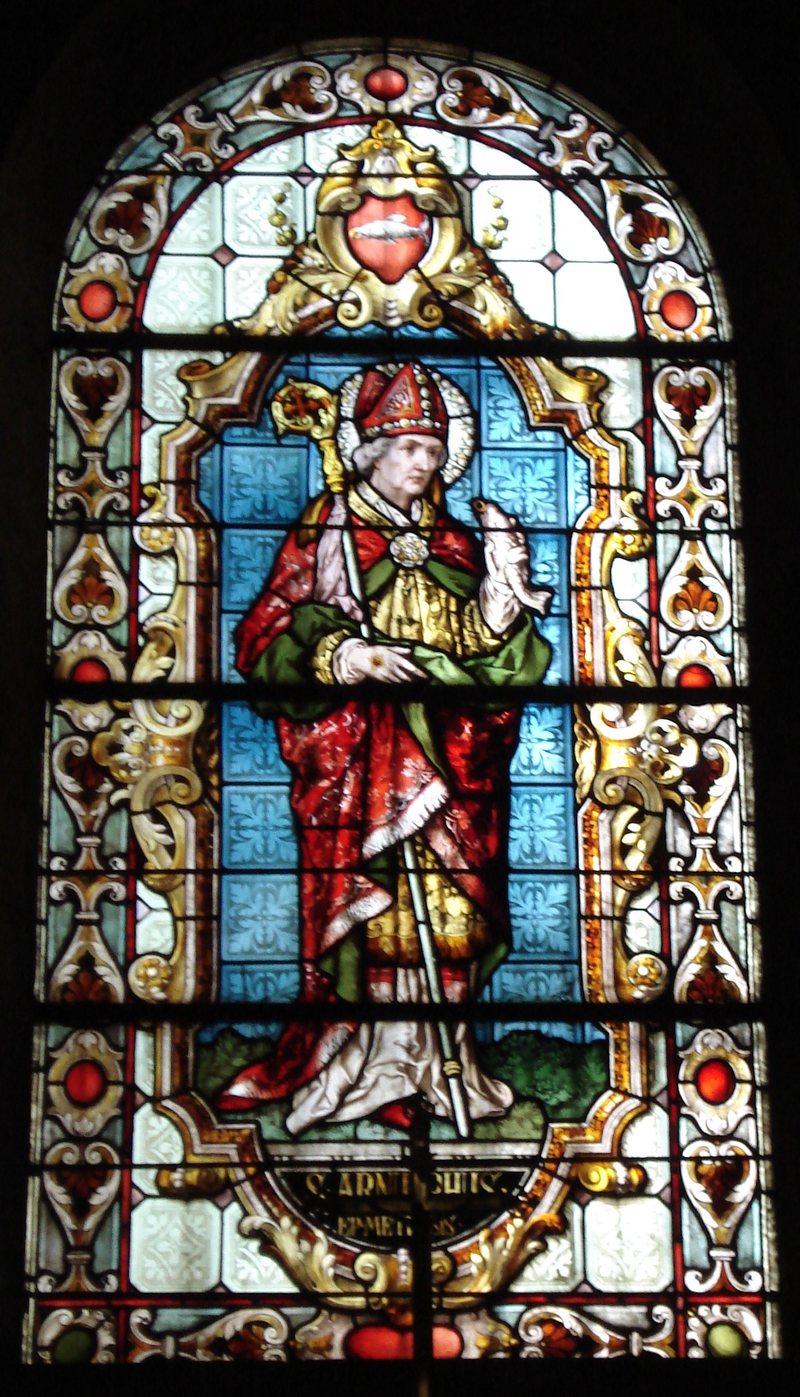
The story goes that Arnulf, troubled by his sins, stood on a bridge over the Moselle, threw his ring into the river and prayed that he might know himself forgiven if it were ever returned. Years later a fisherman brought a fish to the bishop’s kitchen, and the ring was found inside it.
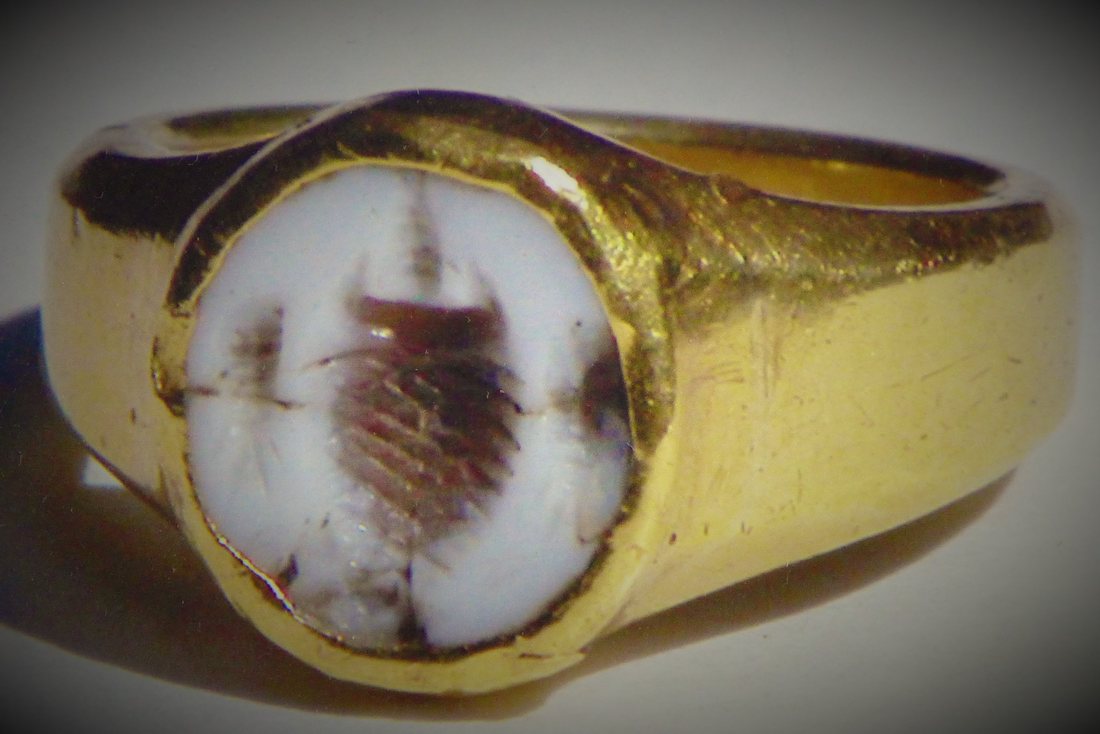
Paul the Deacon records the story. A gold ring said to be Arnulf’s is kept in the treasury of Metz Cathedral. The legend is the source of the Order’s arms and motto.
The beer
A later legend tells that when his body was carried back to Metz in the summer heat, a single mug of beer was enough to refresh the whole procession. He has been a patron of brewers ever since, and the Order drinks his memory in beer.
His feast is kept on 18 July.
The Order
The Order is being founded in Ireland. Its first Annual Meeting will be held there on 18 July 2027, at a venue to be announced.
Its objects are to honour the memory of St Arnulf, to record proved lines of descent from Charlemagne, to promote the study and practice of genealogy and heraldry, and to bring its members together in fellowship and in a better understanding of their shared history. The members may add further objects at the Annual Meeting.
The Annual Meeting and the Feast
The Order holds its Annual Meeting on or near 18 July. The Roll is read, new members are received, the officers report and the members vote. Those who cannot come in person may attend and vote online. The meeting is followed by the Feast, a dinner on the feast day at which the memory of St Arnulf is drunk in beer.
Other meetings are held during the year, in person and online, for talks and for the study of the Order’s subjects.
Chapters
Members living in the same country or region may form a local Chapter, with the consent of the High Steward. A Chapter holds its own meetings and dinners, follows the Order’s statutes and reports each year to the Annual Meeting.
The officers
The Order is led by the High Steward (Major Domus), who is elected by the Hereditary Members for a term of five years, with a Deputy High Steward. The founder is the first High Steward. Any Hereditary Member may stand against him at the first Annual Meeting, and if none does he continues for the first term. The Referendary keeps the Roll and the seal. The Genealogist examines every descent. The Herald has charge of the arms and badge and leads the Order’s work in heraldry. The Prelate says grace at the Feast, and the Cellarer provides the beer.
Questions
- Why St Arnulf, when membership is by descent from Charlemagne?
- The Carolingians venerated Arnulf and held him to be their forefather. Whether he was the father of Ansegisel or a kinsman of the family cannot now be proved, so the Order honours him as patron and asks its members to prove descent from Charlemagne, where the line is not in dispute.
- Is this an order of chivalry?
- No. It is a society of descendants and their friends. It confers no title, rank or precedence, and its members use no letters after their names.
- Does it cost anything?
- There is no fee to join and no subscription. Meetings, dinners and other events are run at cost, shared among those who attend, and never for profit. The Genealogist examines a complete application without charge, and may charge a fee only for research that an applicant asks for.
- Is it connected to a church or a state?
- No. St Arnulf is a saint of the Catholic Church, but the Order is independent and welcomes people of any faith or none.
- Who runs it?
- The High Steward, elected by the Hereditary Members, and the officers the High Steward appoints. All are members, and none is paid for holding office. The Annual Meeting decides changes to the statutes.
Membership
Membership is open to anyone who can prove descent from Charlemagne, and to friends of the Order whom the High Steward appoints. There are two classes of member.
Hereditary Members
Descendants of Charlemagne, through male or female lines, who have proved their descent. Each has a vote at the Annual Meeting.
Companions
Friends of the Order, appointed by the High Steward. They need no descent. They attend and speak at meetings but do not vote.
What counts as proof
Every generation in the line must be supported by a primary source or by a reference work of recognised authority. A link that is likely but not proved does not count. Descent is reckoned from Charlemagne, and the Order makes no ruling on the generations before him.
The burden of proof lies with the applicant. The officers do not carry out research for applicants, though the Genealogist may agree to do so for a fee.
How to apply
- Statement of Descent. You set out your line generation by generation, with the source for each link, and send it to the Genealogist. If your line joins one of the Order’s published gateway ancestors, or a line already certified in the Roll, you need prove it only as far as that person.
- Certification. The Genealogist examines a complete statement without charge and certifies the descent, or declines it with reasons. An incomplete statement is returned unexamined.
- Application for Membership. Once your descent is certified you sign the application, which includes an undertaking to abide by the statutes, and the High Steward admits you to the Roll.
Many people have a descent from Charlemagne through the medieval English, Irish and continental families. The work lies in proving the later generations. The research behind the founding descents is published at damery.family.
Register as a founding member
The Order will admit its founding members before the first Annual Meeting on 18 July 2027. Register here and the Referendary will send you the forms and the statutes.
Arms and Badge
The arms
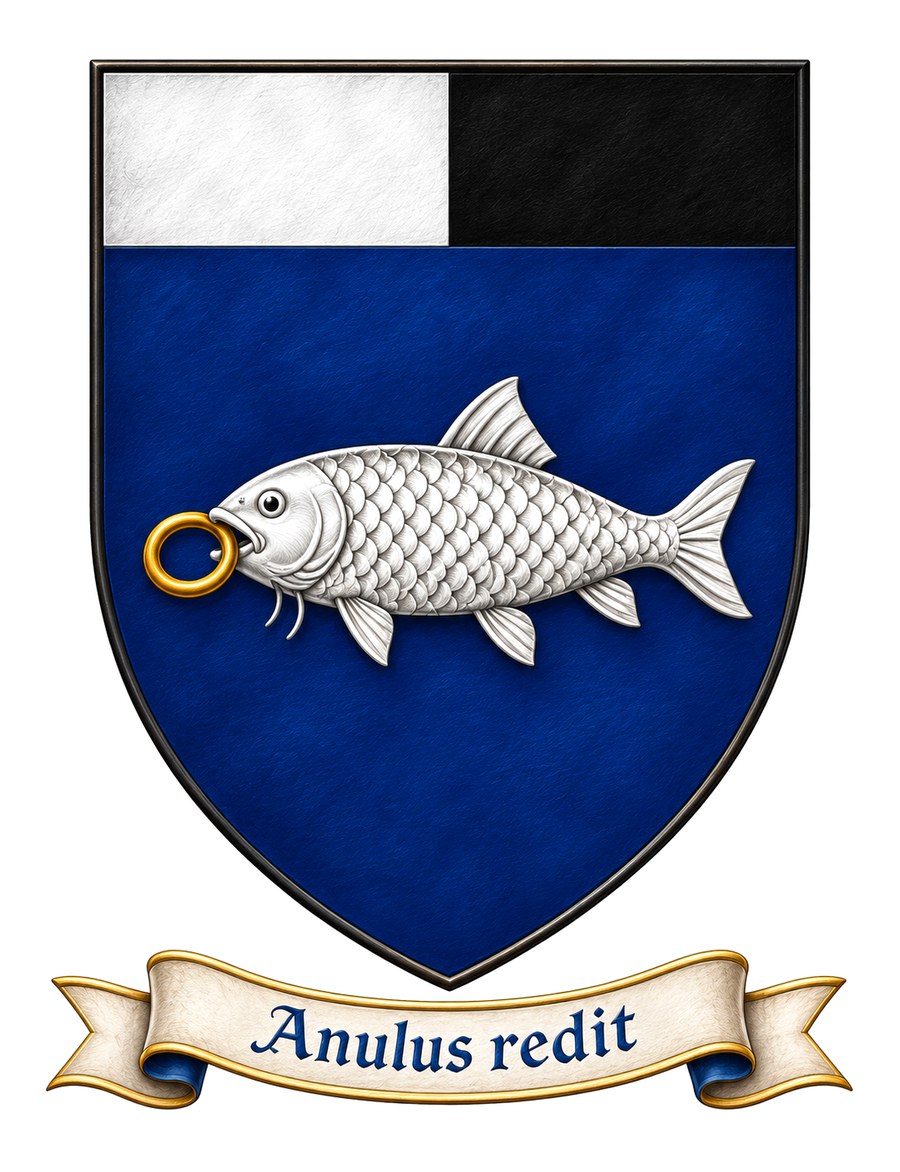
Azure, a barbel naiant Argent holding in its mouth an annulet Or, a chief per pale Argent and Sable.
A silver barbel on blue carries a gold ring in its mouth, for the ring returned from the Moselle. The barbel is a fish of the Moselle country. The white and black across the top are the colours of Metz, Arnulf’s see.
The motto
Anulus redit, “The ring returns.”
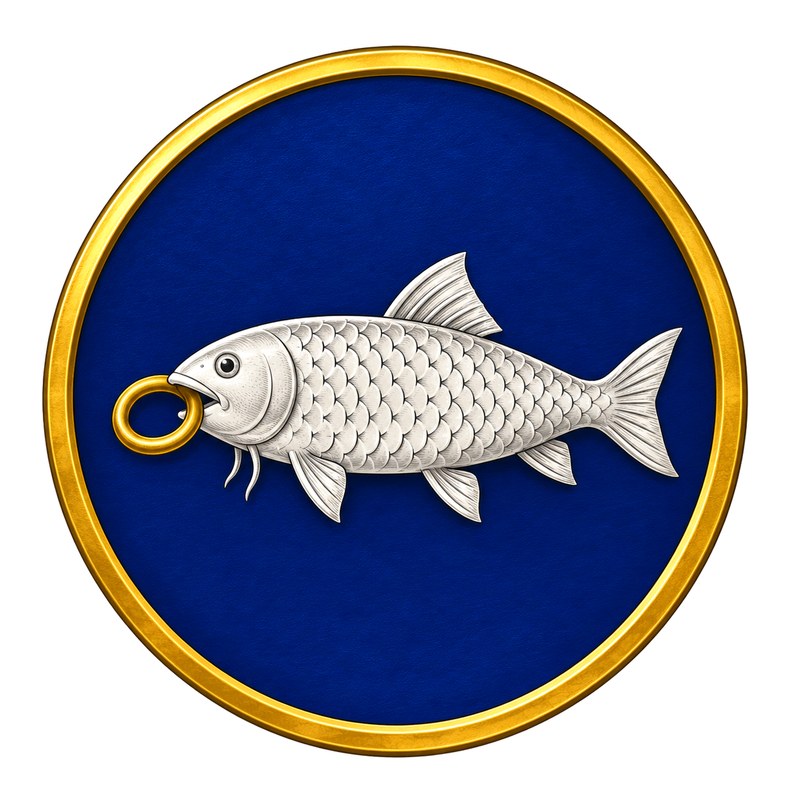
The badge
On a roundel Azure fimbriated Or, a barbel naiant Argent holding in its mouth an annulet Or.
The same fish and ring on a blue disc edged in gold. Members wear it as a lapel pin.
The ribbon
Blue, with a gold stripe at the centre edged in black, and a narrow white stripe at each edge. The four colours are those of the arms.
The arms belong to the Order and are not used by members as their own.